


By Ken Kramer

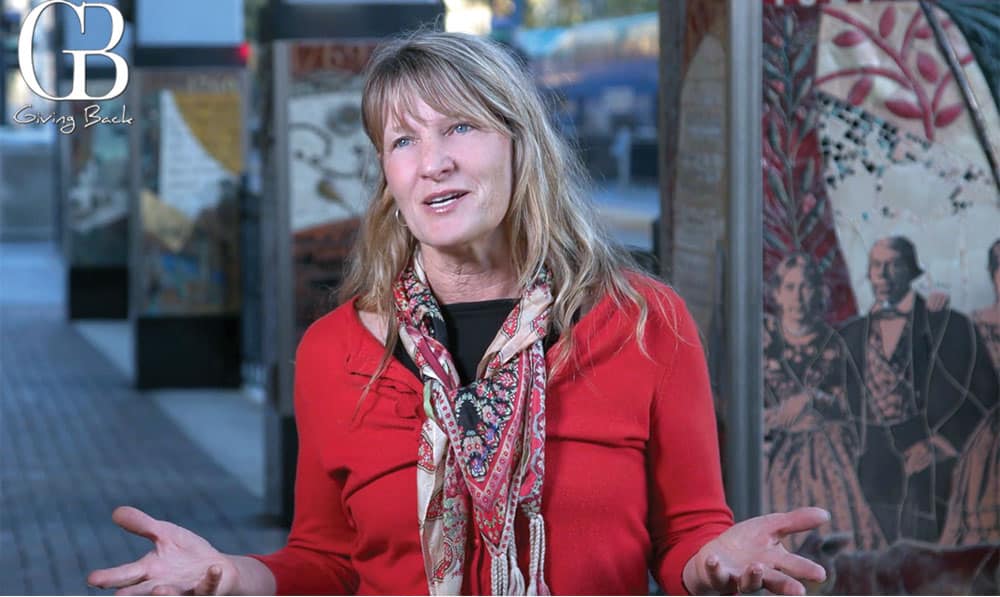
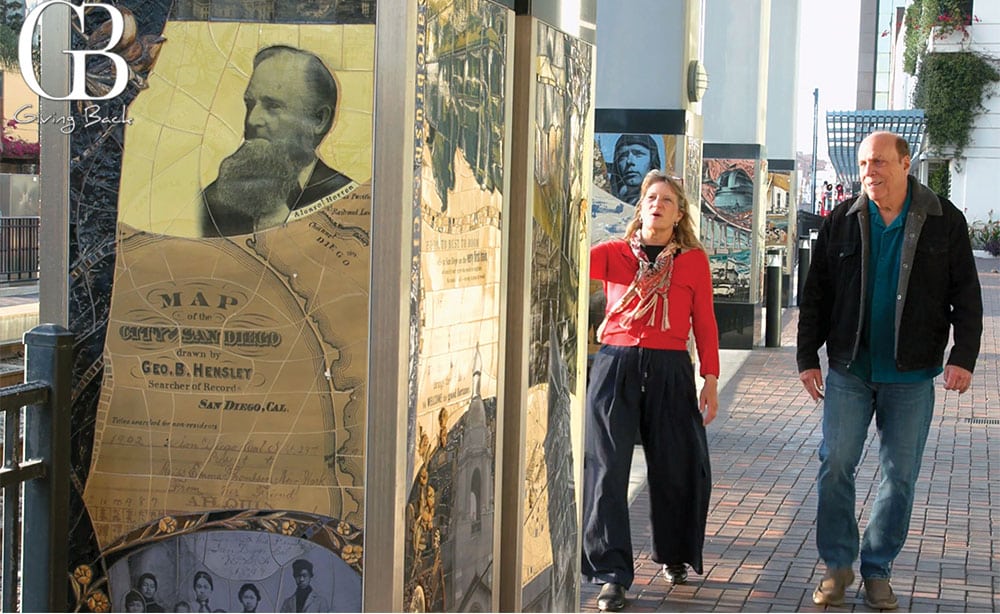
Let’s say you are visiting San Diego, and you want a quick lesson in local history. If you are downtown anywhere near the railroad station, I have got the perfect spot just steps away. Betsy Schulz met me there, on a sidewalk a few dozen yards north of the old Santa Fe Depot. Pausing every couple of minutes to let a noisy trolley, Coaster, or Amtrak train pass, she pointed to ten columns along the public right of way that she has transformed into a timeline of Our City’s past. “Just moving here, of course everybody falls in love with San Diego,” she told me. “I wanted to learn a lot more about it.”
She started reading everything she could about San Diego history. “And not just one book or two books. I read everything I could find, and I put little notes down.” She spoke with Kumeyaay tribal elders.
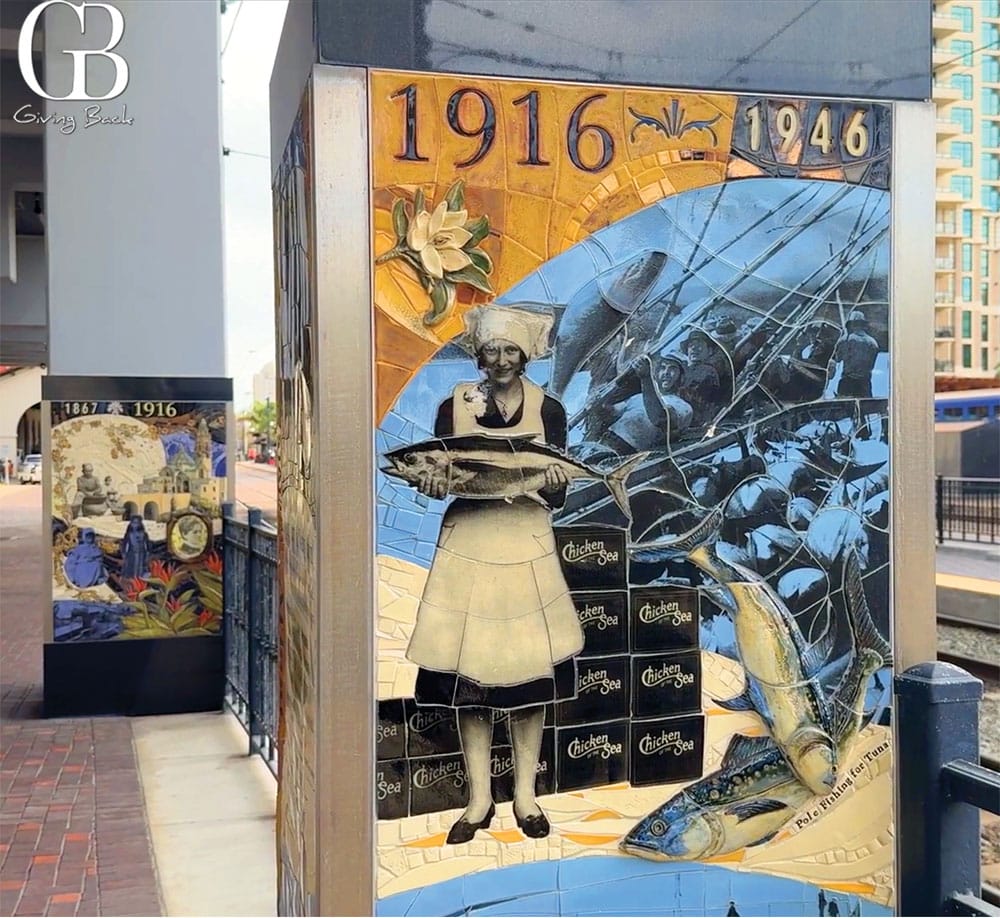
Betsy is a Public Artist. Her acclaimed work adorns community spaces from Fallbrook to Solana Beach, and from Ramona to Carlsbad. But these ten sculptural ceramic murals are a uniquely comprehensive overview of local history. Built as part of the Sapphire Towers development at 1250 Pacific Highway, the columns frame an inviting walkway directly along the east side of the tracks. When Betsy saw them, she imagined that one by one, each could represent a specific period in time. “I thought, I’ll just divide up each era and figure out what makes the most sense based on my research.” Her proposal was accepted by the Towers’ developers, who commissioned the work you see today.
Now, a walk from north to south takes you back to when the Beatles came to town, to when the San Diego Coronado Bay Bridge was built, and through the suburbanization of San Diego. Another column celebrates the period from 1867 to 1916, a time of civic ambition, highlighted by the creation of Balboa Park and a World’s Fair. As you walk along, each stop takes you back further in time. The 1940s, 1820s, 1769, until reaching the southernmost column, devoted to the period before 1542 and the indigenous people who were here first. Betsy pointed to the early inhabitants of San Diego represented on the first column. “It is only one column but literally it should be like, way down the block, because there are thousands of years of this.”
Her work should have a lasting effect. Everything is hand-made and hand-colored. “It is all glazed and it is all fired so it will not fade,” Betsy Schulz says.
It is public art that honors and gives voice to past generations, even in its title: “The Tracks We Leave Behind,” she calls it. It is intricate and creative and engaging. And to that curious visitor, or any of us in search of a quick history lesson, I would say it is just the thing “About San Diego.”